![[personal profile]](https://www.dreamwidth.org/img/silk/identity/user.png) brrm
brrmLong, so I've cut. My answers to ![[livejournal.com profile]](https://www.dreamwidth.org/img/external/lj-userinfo.gif) j4's questions.
j4's questions.
j4 enquired:
1. How would you try to "convert" somebody who wasn't interested in cars? Or wouldn't you want to try? Are there any particular cars that you think are guaranteed to convert someone to thinking that driving is fun?
I've been thinking hard about this one. I have no doubt that there are many people whom it is impossible to convince, but I'd have a go with anyone. :)
There are so many aspects, that I'm sure I will forget some. I'll start with the look of the car as you approach it. It should look like it was designed to drive - not merely a box that fits N people which conveniently has wheels to let it move around, but something that is iconic of its function. I've not expressed that well, I might come back to it.
A good example is a car that looks like it is going fast while it is standing still, but this is not the be-all and end-all of a good-looking car.
Whatever the shape, it should of course be meticulously polished, such that the surrounding scenery falls into the car. Run your fingers along the lines and the curves, feel the frictionless glide that you get after a fresh waxing.
Then you start the car. In many cases, this can be a little ritual. Choke, neutral, a little gas, turn key.
Now we come to the next important factor - sound. It doesn't have to be loud, but a good exhaust note often makes a good car better. In the case of my MG, the resonance comes at about 2500rpm, just before the engine starts pulling with its maximum torque at about 2900rpm. The net effect of this is that the car begins to make a pleasant noise as if to encourage the driver to put their foot down, and pull up to the end of the torque range, and then change gear and do it again.
Steering. This may be, I think, the factor that would put a lot of people off a lot of good cars. The steering on my MG is geared quite high (i.e. not a lot of turns of the wheel to get from lock to lock). This means that one can navigate twisty roads with very mild movements of the steering wheel. The drawback is that major steering operations (parking, pulling out of a t-junction) require sometimes significant muscle-work, which may be difficult for some drivers to manage. Non-power assisted steering such as this will feed back every undulation and bump in the road (not in an unpleasant way), as well as information about the front wheels' traction during cornering. This feedback tends to be lost on most power-steering cars, which gives a less involved experience.
Manoeuvring is a subset of this section. It gives me a curious satisfaction to execute a rapid and technically good 3-point turn, almost as quickly as one would turn on one's heel in a corridor. This is part of the 'car-extending-self' experience, which I'll explain below.
Feedback. Yes. The whole experience involves feedback coming in on all the senses. Feeling the road through the hands on the wheel. Hearing the note of the engine. Seeing the lie of the road ahead, and anticipating it, or the traffic on it. And, perhaps the hardest to describe, the feeling of connection with the car. Personally, and I'm not being rude here, the car becomes an extension of my body. That is, the normal sense in the brain of where the body ends (stops you bumping into people on the street; or knocking things over when reaching for things) becomes extended to encompass the vehicle one is in. There is, I suppose, a little control freakery going on; enjoying the mastery over the metal machine.
Machines. On the conscious mental level, something that I repeatedly marvel at is the technology of the internal combustion engine. It is a collection of pieces of metal more or less bolted together, that can operate in such elegant unison, and not break into a million pieces and fly apart. Italians in particular can not only put together this box of bits to produce a lump of metal that can produce raw power, but also an auditory symphony in metal. For people with bandwidth, you could try taking a listen to The Ferrari 250 GTO. The recording begins with an exterior microphone, but the best part comes with the in-cockpit recording. Listening to this on headphones or reasonable speakers never fails to give me goosebumps, as the engine note rises and rises, until the post-climactic gearchange happens.
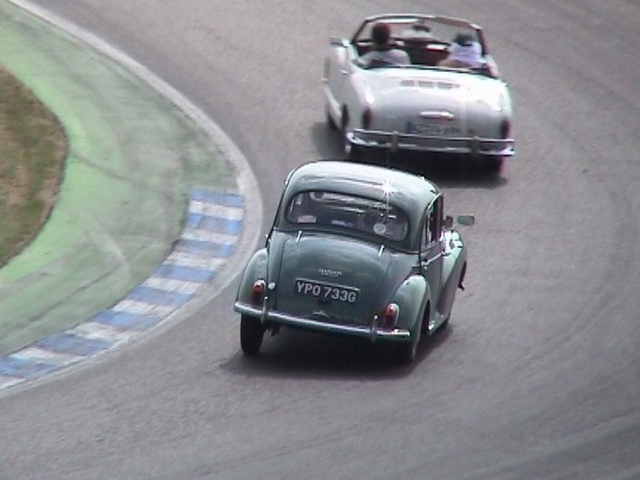
As for particular cars to show off the art of driving - it's not necessarily about going fast, just about how the car behaves at the speeds of which it is capable. Even the Morris Minor is pleasant to drive, as its designer put conscious effort into making it so. While other cars of the day had the rather sloppy-feeling steering-box steering, Issigonis insisted that the Minor have the more responsive rack and pinion steering. Similarly, although the back axle was solid and not independently sprung in the name of cost, the front suspension consisted of the torsion-bar design as seen on Porsches (the use of the design in the Minor was one of the spoils of WWII). Thus, I could trust the handling to be both predictable and entertaining while driving round the Hockenheimring Formula 1 track. :-)
There, ramble over. Ahem.
You could also try reading this article - a conversation between a car person and a non-car person.
A similar issue also arises in Zen And The Art Of Motorcycle Maintenance - there are those who have an affinity with modern technology such as cars and computers, and those which see them as an appliance, do not understand the warning signs and are helpless when they go wrong. I haven't finished the book, though.
2. Aliens are going to destroy Oxford and Cambridge, but you have the power to save just one of these great university cities. Which do you save, and why? Would your answer change if all the people in the cities were going to escape destruction anyway?
Eep. I'm afraid I think I'm going to have to say Oxford for the moment. The Cambridge that existed when I was growing up there, or rather, the bits that were interesting and important to a boy aged up to 10, are mostly gone now. Almost all the shops, with the exception of Games & Puzzles on Green St have been replaced with mobile coffee phone shops (not that this is unusual). R & D Models still exists, but moved out to the Grafton Centre last I knew. The walk from Clarkson Road to the city centre is as it was, though, so I'd miss that. Until recently, I didn't have many memories associated with Cambridge, though I'm accumulating them, and getting to know the place better again. Re-acquainting myself with a childhood friend. :-)
Oxford feels like home (ignoring parental home in Germany for the moment), probably because I've spent longer here than anywhere else except Cambridge now. I don't think I'll live here forever, but I'd like to play at being settled for a bit, after 14-odd years of moving back and forth and around. It doesn't seem to be changing much, probably because I'm here, so see many little changes. I'm sure when I return here after several years' absence, it will seem changed and strange to me.
I wouldn't change my answer based on the people, but having said that, it makes it harder for me to wish destruction on either place. Can I ferry the Cambridge people to safety one at a time in my MG? :-)
3. If you could read the mind of one other person, whose mind would you read, and why?
This is going to sound self-absorbed, but I'd really be happy reading the mind of anyone who had met me. Ideally, one of each of people liked me, people who disliked me or had ever found me irritating, or even hated me (if such people existed, of course, ho ho), people who counted me as a close friend, people who loved me (do they?), people who were attracted to me. Oh, and someone who'd interviewed me for a job - it'd be nice to know what they were thinking. Just to know a bit about myself from the outside; what I'm doing right and wrong, how I can improve. Cheesy, eh?
4. If you couldn't use a Mac, what would be your computer/OS of choice, and why? Do you think there's any job for which a Mac is not the right tool? (I mean, apart from silly things, like you probably can't use it as a jam-strainer.)
Well, actually, the case of a Mac Plus probably could be used as a jam-strainer. The little ventilation slots in the top, see, they'd work quite well. Erm.
A few years ago, before the advent of OS X, it was clear that there were tasks to which MacOS in its current incarnation was not suited. Being a server, or being a multi-user machine, for example. Now that Macs are more or less Yet Another Unix Machine (I won't go into their strengths here), the weaknesses I mentioned above no longer apply. The Mac's main weakness now is probably price, both of the hardware and of a fair amount of the software. For me personally, it is worth it. I prefer the user experience, and know I can trust the hardware to be reliable for many years. Laptop hardware I think is a particular strength for Apple (though there have been hiccups in the past).
5. You have to give a short talk (define "short" however you like) to all the people on your friends-list, on a subject other than motorised vehicles or computers -- what do you choose to talk about?
If it was going to be a talk that would be enlightening and improving to the recipients (oh yes), I think it might well have to be a crash course in biochemistry, in particular the parts relevant to the current biotechnology boom - how DNA is turned into proteins and some interesting examples of proteins. For those who know such things, molecular motors are a particularly impressive example of protein function, to me. I'd have to do a little revision first, of course - it's been a while now.
There, I hope my answers haven't been too boring or rambling, but I enjoyed putting them to, er, paper. Thanks!
j4's questions.j4 enquired:1. How would you try to "convert" somebody who wasn't interested in cars? Or wouldn't you want to try? Are there any particular cars that you think are guaranteed to convert someone to thinking that driving is fun?
I've been thinking hard about this one. I have no doubt that there are many people whom it is impossible to convince, but I'd have a go with anyone. :)
There are so many aspects, that I'm sure I will forget some. I'll start with the look of the car as you approach it. It should look like it was designed to drive - not merely a box that fits N people which conveniently has wheels to let it move around, but something that is iconic of its function. I've not expressed that well, I might come back to it.
A good example is a car that looks like it is going fast while it is standing still, but this is not the be-all and end-all of a good-looking car.
Whatever the shape, it should of course be meticulously polished, such that the surrounding scenery falls into the car. Run your fingers along the lines and the curves, feel the frictionless glide that you get after a fresh waxing.
Then you start the car. In many cases, this can be a little ritual. Choke, neutral, a little gas, turn key.
Now we come to the next important factor - sound. It doesn't have to be loud, but a good exhaust note often makes a good car better. In the case of my MG, the resonance comes at about 2500rpm, just before the engine starts pulling with its maximum torque at about 2900rpm. The net effect of this is that the car begins to make a pleasant noise as if to encourage the driver to put their foot down, and pull up to the end of the torque range, and then change gear and do it again.
Steering. This may be, I think, the factor that would put a lot of people off a lot of good cars. The steering on my MG is geared quite high (i.e. not a lot of turns of the wheel to get from lock to lock). This means that one can navigate twisty roads with very mild movements of the steering wheel. The drawback is that major steering operations (parking, pulling out of a t-junction) require sometimes significant muscle-work, which may be difficult for some drivers to manage. Non-power assisted steering such as this will feed back every undulation and bump in the road (not in an unpleasant way), as well as information about the front wheels' traction during cornering. This feedback tends to be lost on most power-steering cars, which gives a less involved experience.
Manoeuvring is a subset of this section. It gives me a curious satisfaction to execute a rapid and technically good 3-point turn, almost as quickly as one would turn on one's heel in a corridor. This is part of the 'car-extending-self' experience, which I'll explain below.
Feedback. Yes. The whole experience involves feedback coming in on all the senses. Feeling the road through the hands on the wheel. Hearing the note of the engine. Seeing the lie of the road ahead, and anticipating it, or the traffic on it. And, perhaps the hardest to describe, the feeling of connection with the car. Personally, and I'm not being rude here, the car becomes an extension of my body. That is, the normal sense in the brain of where the body ends (stops you bumping into people on the street; or knocking things over when reaching for things) becomes extended to encompass the vehicle one is in. There is, I suppose, a little control freakery going on; enjoying the mastery over the metal machine.
Machines. On the conscious mental level, something that I repeatedly marvel at is the technology of the internal combustion engine. It is a collection of pieces of metal more or less bolted together, that can operate in such elegant unison, and not break into a million pieces and fly apart. Italians in particular can not only put together this box of bits to produce a lump of metal that can produce raw power, but also an auditory symphony in metal. For people with bandwidth, you could try taking a listen to The Ferrari 250 GTO. The recording begins with an exterior microphone, but the best part comes with the in-cockpit recording. Listening to this on headphones or reasonable speakers never fails to give me goosebumps, as the engine note rises and rises, until the post-climactic gearchange happens.
As for particular cars to show off the art of driving - it's not necessarily about going fast, just about how the car behaves at the speeds of which it is capable. Even the Morris Minor is pleasant to drive, as its designer put conscious effort into making it so. While other cars of the day had the rather sloppy-feeling steering-box steering, Issigonis insisted that the Minor have the more responsive rack and pinion steering. Similarly, although the back axle was solid and not independently sprung in the name of cost, the front suspension consisted of the torsion-bar design as seen on Porsches (the use of the design in the Minor was one of the spoils of WWII). Thus, I could trust the handling to be both predictable and entertaining while driving round the Hockenheimring Formula 1 track. :-)
There, ramble over. Ahem.
You could also try reading this article - a conversation between a car person and a non-car person.
A similar issue also arises in Zen And The Art Of Motorcycle Maintenance - there are those who have an affinity with modern technology such as cars and computers, and those which see them as an appliance, do not understand the warning signs and are helpless when they go wrong. I haven't finished the book, though.
2. Aliens are going to destroy Oxford and Cambridge, but you have the power to save just one of these great university cities. Which do you save, and why? Would your answer change if all the people in the cities were going to escape destruction anyway?
Eep. I'm afraid I think I'm going to have to say Oxford for the moment. The Cambridge that existed when I was growing up there, or rather, the bits that were interesting and important to a boy aged up to 10, are mostly gone now. Almost all the shops, with the exception of Games & Puzzles on Green St have been replaced with mobile coffee phone shops (not that this is unusual). R & D Models still exists, but moved out to the Grafton Centre last I knew. The walk from Clarkson Road to the city centre is as it was, though, so I'd miss that. Until recently, I didn't have many memories associated with Cambridge, though I'm accumulating them, and getting to know the place better again. Re-acquainting myself with a childhood friend. :-)
Oxford feels like home (ignoring parental home in Germany for the moment), probably because I've spent longer here than anywhere else except Cambridge now. I don't think I'll live here forever, but I'd like to play at being settled for a bit, after 14-odd years of moving back and forth and around. It doesn't seem to be changing much, probably because I'm here, so see many little changes. I'm sure when I return here after several years' absence, it will seem changed and strange to me.
I wouldn't change my answer based on the people, but having said that, it makes it harder for me to wish destruction on either place. Can I ferry the Cambridge people to safety one at a time in my MG? :-)
3. If you could read the mind of one other person, whose mind would you read, and why?
This is going to sound self-absorbed, but I'd really be happy reading the mind of anyone who had met me. Ideally, one of each of people liked me, people who disliked me or had ever found me irritating, or even hated me (if such people existed, of course, ho ho), people who counted me as a close friend, people who loved me (do they?), people who were attracted to me. Oh, and someone who'd interviewed me for a job - it'd be nice to know what they were thinking. Just to know a bit about myself from the outside; what I'm doing right and wrong, how I can improve. Cheesy, eh?
4. If you couldn't use a Mac, what would be your computer/OS of choice, and why? Do you think there's any job for which a Mac is not the right tool? (I mean, apart from silly things, like you probably can't use it as a jam-strainer.)
Well, actually, the case of a Mac Plus probably could be used as a jam-strainer. The little ventilation slots in the top, see, they'd work quite well. Erm.
A few years ago, before the advent of OS X, it was clear that there were tasks to which MacOS in its current incarnation was not suited. Being a server, or being a multi-user machine, for example. Now that Macs are more or less Yet Another Unix Machine (I won't go into their strengths here), the weaknesses I mentioned above no longer apply. The Mac's main weakness now is probably price, both of the hardware and of a fair amount of the software. For me personally, it is worth it. I prefer the user experience, and know I can trust the hardware to be reliable for many years. Laptop hardware I think is a particular strength for Apple (though there have been hiccups in the past).
5. You have to give a short talk (define "short" however you like) to all the people on your friends-list, on a subject other than motorised vehicles or computers -- what do you choose to talk about?
If it was going to be a talk that would be enlightening and improving to the recipients (oh yes), I think it might well have to be a crash course in biochemistry, in particular the parts relevant to the current biotechnology boom - how DNA is turned into proteins and some interesting examples of proteins. For those who know such things, molecular motors are a particularly impressive example of protein function, to me. I'd have to do a little revision first, of course - it's been a while now.
There, I hope my answers haven't been too boring or rambling, but I enjoyed putting them to, er, paper. Thanks!